📦 This is a read-only archive of Miss Geeky. Looking for Melinda? Visit her current site at seckington.com.

The Art of Slide Design

August 4th, 2017

Last weekend I gave a talk at DevRelCon Tokyo called The Art of Slide Design. This is pretty much the blog post version of my script/speaker’s notes for it, albeit split out over several posts!

I’ll be publishing the posts over the next couple of days, starting today with the intro (this post) and the first principle Maximise Signal, Minimise Noise.

I’m also planning on doing some followup posts to go into more detail about some of the topics (like choosing custom fonts and creating animations). For now though, this is staying pretty true to the original talk. Check out the full slides on SpeakerDeck.
Art of Slide Design.001

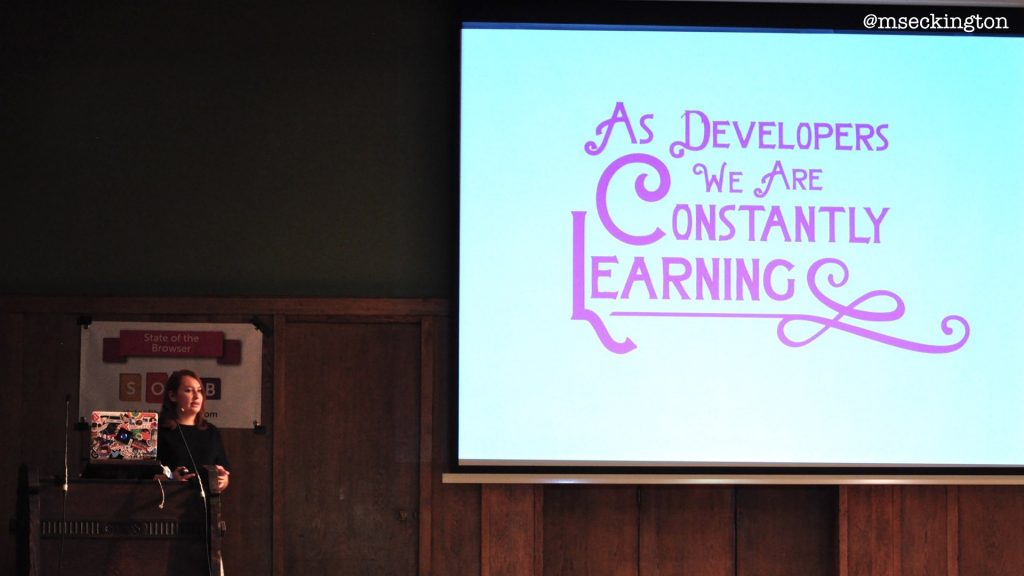
As I’ve mentioned before on this blog, for most of my life I hated giving presentations – as a kid, as a teen, as a university student. I was so scared and nervous in front of people that I tried to avoid giving them as much as I could. Whenever I did have to do one, I’d be a bunch of nerves for the entire week before, and often because of my nerves the presentation wouldn’t turn out that great. I didn’t believe it was something I’d ever be able to do well and I really didn’t believe it was something I’d ever enjoy.

Nowadays I actually like giving presentations. For the past 3 years, I’ve been giving talks at meetups and conferences, and part of my role at FutureLearn is to encourage my team to both blog and speak more (read more about that in my post about employee evangelism).
Art of Slide Design.004

For me, the secret, the magical solution, came from preparation.

I find that whenever I try to learn something new, it becomes easier for me if I understand all the different aspects, all the different building blocks of what it is that I’m to learn. With presentations it was about understanding my emotions and how my face and body and voice were reacting when I got nervous. It was about understanding how to tell compelling stories and how to keep the audience engaged. It was about discovering how often I need to practice until I feel completely comfortable with what I’m going to say. And it’s about understanding how to use the tools I have in the most effective way.
Art of Slide Design.005

Alongside our voice and our words, our slides are the most important instrument in our presenter’s toolbox. And we should learn to use them as effectively as we can.

Nowadays after most of my talks, I’ll often get compliments that people really liked my slides, sometimes with the sly additional question whether I got someone else to create them (nope, just me). Just like mastering other skills, once you know some of the tricks, it does get easier the more you do it.

So that’s what this series of blog posts are about: how to create effective slides.

But what does that mean? What makes your slides effective?
Art of Slide Design.006

Let’s take a step back and look at why we are presenting in the first place: what’s the goal of a presentation? At first glance you might think each presentation is different: some will be about teaching a new skill or knowledge, some will be to convince people to use a specific product, some will be to inspire and motivate people to change or do something.

There are endless goals of what a presentation is for and no two presentations will be the same.
Art of Slide Design.007

Yet at the heart of it, they all have one thing in common: no matter what your motivation behind the presentation is, your #1 goal as a presenter is to allow your audience to absorb your information. Whether you’re trying to teach, convince, motivate, frighten, sell, inspire – it’s your responsibility to make that easier for your audience.
Art of Slide Design.008

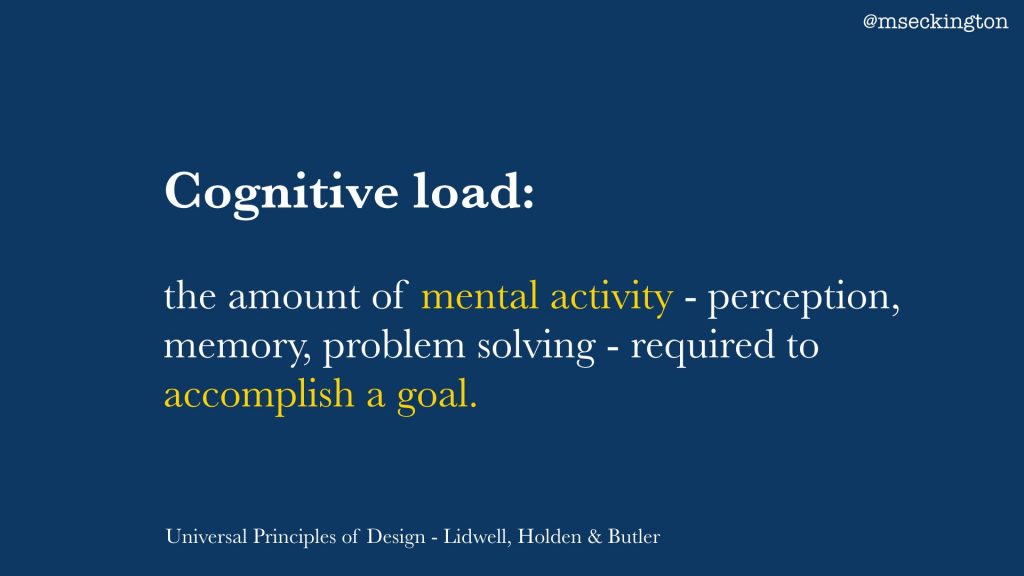
This all ties in with the concept of cognitive load: the amount of mental activity – perception, memory, problem solving – required to accomplish a goal.
Art of Slide Design.009

This definition comes from the book: Universal Principles of Design and I’ll be referring to it a couple of times throughout these blog posts. It’s a great resource book covering 125 design principles and ties it back to psychology and physiology research.
Art of Slide Design.010

In that book we also find this quote about cognitive load: design should minimise cognitive load to the greatest degree possible.
Art of Slide Design.011

So when we talk about effective slides, we mean slides that help reduce that cognitive load.
Art of Slide Design.012

Slides that help rather than prevent people from consuming your information.
Art of Slide Design.013

So how do you create effective slides? How do you create slides that are compelling and help your audience?
Art of Slide Design.014

The answer lies in shifting that question to: how do you design effective slides? We can get a better understanding of slide design, by looking at design theory.
Art of Slide Design.015

In the next few posts, I want to share 4 principles of slide design, so that you can create more compelling slides and help your audience absorb the information you’re presenting.

One thing to bear in mind here is that I don’t believe there is “one true way” of creating slides. This isn’t about getting you all to create the same type of slides that I do – rather it’s helping you get a basic understanding of design theory and applying it to your own style.

If you’re starting out, don’t feel like you have to attempt changing all of your slides in one go: choose one principle to apply to your next presentation and build from there. Hopefully you’ll be able to hit the ground running with some of the tips in these post and make your slides a little bit more unique and effective.

Let’s start with the first principle: Maximise Signal, Minimise Noise.

Enjoyed this post and want more? Follow me on Twitter: mseckington. You might also like: Employee Evangelism: Make Your Team Badass, Blogging tips: How to start writing , How I got into conference speaking and Imposter Syndrome: How we act and work together.

I love these photos from Amusement featuring game consoles as buildings:

PS3-Building
NDS-Building
NES-Building

Cool, right? I wish they’d make more of these. Like can you imagine how a GameBoy building would like? Or an Xbox building? Check out the Amusement site for larger versions of these photos.

I love love love these jewelry designs from Molly M Designs. They are just so simple and elegant, but with a mathematical twist.

lasercut_wood_rings

The story behind the store is pretty interesting too. Molly McGrath is professionally trained as an architect and after using a laser cutter to make architectural models, she realized the machine potential to make unique jewelry. Each design starts out with a sketch, which are then drafted into AutoCAD and printed on the laser cutter.

lasercut_vortex

lasercut_intersect

From what I can see on the site, every design is available as earrings or as a pendant. Depending on the design, they are available as small or large. Here are the prices: small earrings are $36, large earrings are $46, small pendants are $36 and large pendants are $46.

lasercut_burst

Via Design Crush

I love my new apartment, but there are some ‘interesting’ walls with which I can’t do that much. A photo frame like this would fit perfect though!

wraparoundthecornerframe

The frame is available on Photojojo.com for $119 (or $99 if you blog or tweet about it).

This is such a great idea! Paint to transform a random wall into a white board!

16_idea-paint-9

I love white boards. I used to have one in my student flat, but never got around to getting one after moving to London. I always wanted a nice big one to be able to scribble anything I wanted on it. But an entire wall? I hadn’t even thought about that. It would be perfect!

16_idea-paint-0

Sadly though the price for IdeaPaint is on the high side: it’s $200 per 50 square feet. For that size I can easily find a much much cheaper solution.

I’m a big movie fan, so you’d think I would enjoy going to the cinema. To be honest, I kind of still do. Where else can you see the newest movies on a nice big screen with great sound? But a part of me sees the actual experience as a chore. Yes, I want to see movies in the cinema, but there are so many things wrong with the cinema experience that I wonder if it is actually worth it. If you have a big enough TV set at home, what is the added value of going to the cinema? The traditional concept of the movie-going experience desperately needs a complete reinvention (FourStarters did a post about this a while back).

Cinema by rpb1001
Photo from Flickr by rpb1001

This is the first in a series of posts where I want to focus on how cinemas should be (and in some cases are) adapting to the altered demands of cinema visitors. Before we actually come to that though, I want to identify the common problems that occur with today’s cinemas. Keep in mind that these are 10 general problems; it doesn’t mean that all cinemas have each of these problems, although most of them will have more than one problem. Some of these problems also have very simple solutions, but none the less they keep occurring.

1. Poor Projection Quality

Raise your hands if you’ve ever been to a cinema where the movie was out of focus or had too many scratches on it. I’m hoping a lot of you just raised your hands (or at least nodded in agreement) and are annoyed by the fact that this happens so often, but the truth is most movie audiences don’t care about the projection quality. Poor projection quality is purely caused by incompetent projectionists, who mishandle the reels and don’t adjust them properly [FirstShowing]. If movie goers would complain about this, something might be actually done, but the fact is most people don’t complain.

I’ve had a couple of times that we were the only ones during a crappy showing that stood up, left to find an employee and complain about the quality. Some people might just be plain lazy or don’t think it’s something worth complaining about (which I find ridiculous, you’re paying to see this movie here, right?), but most people just don’t know what good projection quality is [FirstShowing]. They’ve never experienced how it should be done the right way; this bad projection quality is all they’ve ever known. It’s a problem, which has a simple solution (train/force the projectionists to set-up the movie properly), but if people don’t see it as a problem nothing will be done about it.

Projection

2. Bad Volume

With bad volume I mean that the movies in cinemas are too loud or too soft, or something a bit in between, where in the same movie the action sequences are too loud and the dialogue is too soft. I always thought this was again simply a problem with cinemas, but after doing some reading, I found out it’s a bit more complex than that and not always the cinema’s fault.

Some times the cinema does turn up the volume way too loud, but that’s not always the case. Nowadays a lot of movies are actually made too loud (as in containing segments above 90 db) and cinemas show them as they are meant to be shown, meaning it is often the fault of the studio that produced the movie. Other times the cinema chooses to lower the volume, so that too loud parts are under the allowed limit, but which causes the rest of the film to be too soft. This same thing can occur when the sound is adjusted for trailers in front of the film. This article gives a good example of an action movie trailer in front of a romantic comedy. The volume is turned down, because the trailer is too loud and the volume stays this way for the entire movie.

3. Screen Size

People often complain that some cinema screens are too small and that a bigger screen means a better experience. I disagree. In my eyes it’s all about the relative screen size (I’ve touched on this before in Why Expensive Cinemas Are Not Necessarily Better). It doesn’t matter how big the screen is, if you’re sitting far away from it. I’ve been to the Empire and the Odeon cinemas at Leicester Square and both screens (and auditoriums) are huge. The seats though, are placed on a not so very steep slope, so you’re sitting either A) quite far from the screen, or B) too low and have to stare upwards. Compare that to the Vue at Shepherd’s Bush or the Pathe Schouwburgplein in Rotterdam. Those are smaller auditoriums with smaller screens, but the seats are placed on a much steeper slope, so it feels like the screen is much bigger. Cinema auditoriums should be designed to give the movie goer the best view, preferably no matter where you sit.

Cinema by rpb1001
Photo from Flickr by adpowers

4. Bad Seats

Auditoriums are filled with as many seats as possible, not thinking at all of giving the optimal experience to the movie goer. Most of the time the seats are uncomfortable and small with not enough leg space. Then you have the theaters where all the rows are on the same level (no slope); if it’s busy, chances are somebody is going to sit in front of you and block your view. Of course this is all because they want as many seats as they can in one auditorium.

This is completely silly though, cause more often than not most of the seats will be empty. Yes, Friday and Saturday night might be packed, but the rest of week? It’s never, ever busy. Cinemas should discard the idea of filling as much seats as possible and try to cater to the ultimate movie experience. Get nice big comfortable seats and place them in such a way that from every seat you have a good view.

5. Coat and Bag Space

Question: you’re already stuck in a crappy seat with no leg space, so what do you with your coat and bags? Answer: you put it on the chair next to you. Nobody really wants to admit it, but everybody does it. If you’re with the two of you, you’re most probably taking up at least 3 seats (maybe even 4 sometimes). Doesn’t matter that you haven’t actually payed for those chairs, you’re going to put your stuff there. And if it’s busy? Well, then you’re forced to sit on your coat in your already uncomfortable seat and put your bags amid your already limited leg space. Why, oh, why can’t they find a solution for something as obvious as this?

Cinema by rpb1001
Photo from Flickr by emdot

6. Air Conditioning

Cinemas are always ice freakingly cold. Now I understand why they do this; they’d rather have cold people, then sweaty, smelly people, right? But does it really have to be that chilly in there? It also wouldn’t be too bad, if you could snuggle up to your significant other. But no, the seats are too crappy to be able to do that (btw why are love seats always right on the back?). Turn down that air conditioner, please, we’re not popsicles.

7. Seat Selection

Okay, now I know this point really depends on the cinema; some cinemas handle it pretty well. I’m just ticked off by a couple of irritating past experiences. With seat selection I mean how the cinema deals with people picking their seats. A lot of cinemas still gives tickets with specified seat numbers, but you never really know if they’re going to abide to these seat numbers or not. I’ve had a couple of times that I reserved certain seats on opening night, only to show up and find out you can sit anywhere you want (one time for 13 people). Other times I’ve had it the other way around and you’re forced to give up your seats. While I really don’t mind one option over the other, I want to know before hand which of these rules to abide by. What always seems to work is tickets with no specified places. You just show up and claim your seats, first come, first serve, no hassle.

Cinema by rpb1001
Photo from Flickr by ninjapoodles

8. No Decent Waiting Area

Again this depends per cinema, but most don’t have a proper waiting area. Some of you might argue that it’s also completely unnecessary, but again I think it would add value to the whole cinema experience. Nobody ever arrives right on time when the movie’s about to start and most of the time you can’t go into the theater right away. There should be some area where you can sit down, get a drink and wait. I also see such an area not only being used before the movie starts, but also after it, a place where you can sit down for a moment and talk about the movie.

9. Queues

While some cinemas have solved the problem of queues by using terminals, there a still a lot of them that don’t use them yet. Almost all cinemas I’ve been to here in London have terminals and this significantly cuts down the queues. But even without terminals, there’s a way to do smarter queue management. One particular cinema springs to mind, where even though you had reserved for a movie, you still had to pick up your reserved tickets in the same queue as all the people trying to buy a ticket for the same show. I hated this because all they had to do was scan my reservation and my discount card (you could buy a set of 6 tickets in one go on one card). Instead I had to stand in line with these people who hadn’t taken the time to reserve tickets. On busy nights these people often had a slim chance of getting in anyway, so they were wasting my and their precious time. You would think there would be a way to process reservations separately?

Then you also have the horrible queues at the concession stands, prompting me never to get anything cause it just takes too long (plus side: it’s cheaper and healthier). What I find the most exasperating innovation: the combined tickets and concessions booth? Yes, let’s make people wait even longer in line!

Cinema by rpb1001
Photo from Flickr by lorch

10. Movie Showing Duration

Problem number 10 is just a minor problem, but honestly “9 problems” doesn’t seem as catchy as 10. So my last problem with cinemas is that in some it is very unclear for what (often very short) period of time a movie runs in the cinema. This problem really depends on where you live and how big your town/city is. I understand the “why” behind it: for smaller cinemas it is sometimes not worthwhile to have a movie play for a longer amount of time. This doesn’t lessen the irritation though when you come to the realization that a movie was only playing for 1 week in the cinema and you missed it.

Tags: Cinema, Movies